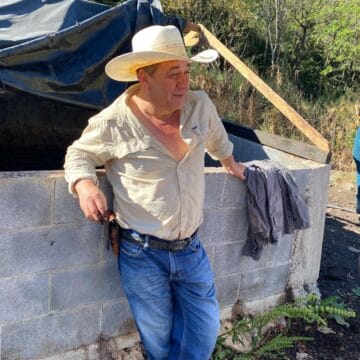
Marvin bought his first parcel of land in this area in 1990. Over the decades they added to their holdings with various parcels of land as the business became more and more profitable. Over the years he has improved the farm practices, replanted some of the older trees, and implemented a system of shade management to improve the farm. Now, he operates a wet mill in addition to Finca Las Brisas.
At the wet mill, Marvin works to ensure smart water usage, including care with processing wastewater. Without proper processing, wastewater can contaminate soil and water sources. His system involves 8 wastewater ponds, and after treatment clean water emerges from the 8th. He also uses a water pump to recirculate clean water, which helps reduce water use at the mill.
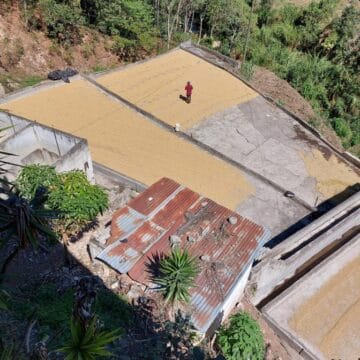
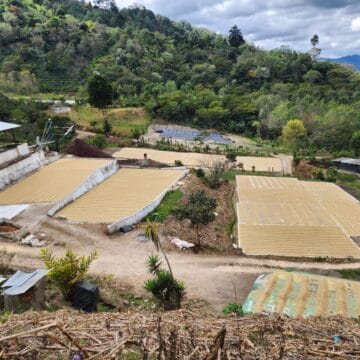
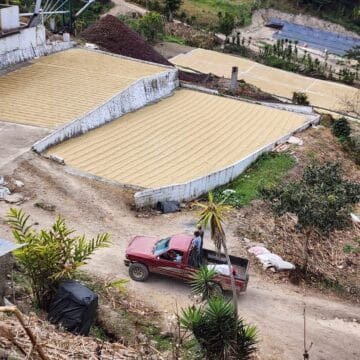
Washed and sundried. After depulping, the coffee ferments for about 12 hours before being washed and placed on the patio to dry.
What does the future hold?
Marvin hopes to continue growing and continue improving the quality of the coffee, to continue incorporating more organic and sustainable fertilizers, and to improve a little more each year!
Marvin tells us that coffee has brought many benefits to the community – in addition to coffee from Las Brisas, he also buys cherry from his neighbors and mills it for Primavera. He tells us that coffee has not only helped improve the income and job opportunities of local coffee producers, but also that the community has better roads, schools, and a health clinic as the local coffee economy grows.
La Cumbre is a small coffee farm in San Antonio Huista, Huehuetenango, managed by Yolanda Guadalupe Ramírez Pérez.
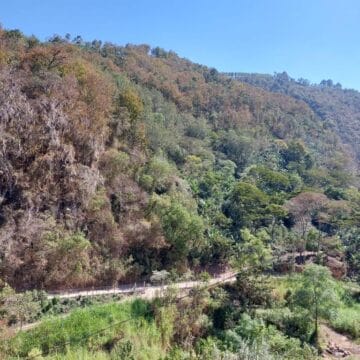
At approximately 1,600 metres above sea level, Yolanda grows Caturra and Bourbon on a parcel of around 1.6 hectares. Her coffee is traditionally washed, producing a cup with the clarity and vibrant acidity we associate with some of the best coffees from this part of Huehuetenango.
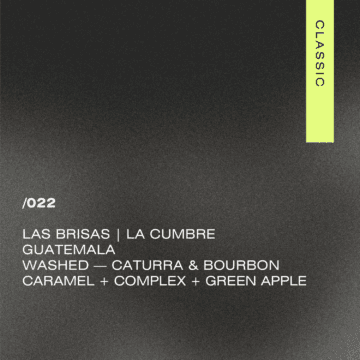
For /022 Filter, La Cumbre gives us exactly what we were looking for. It retains the sweetness and approachable character that defines /022, but brings considerably more complexity and energy than the coffee we use for espresso. There is a brighter, more expressive acidity, layered fruit and a sweetness that continues to develop as the coffee cools.
This is why /022 is now intentionally different between brewing styles. Las Brisas gives us the richness, body and lower acidity we want from espresso, while La Cumbre is allowed to show its more delicate and complex side as a filter roast.
On espresso: Expect macadamia and malic acidity. Green grapes, full bodied and a chocolate finish.
On filter: High complexity, caramel sweetness and beautiful green apple notes. A profile that tastes like a cup you want to wake up with everyday.
It’s a classic coffee on filter that you don’t drink from a tiny delicate porcelain cup, but a coffee that deserves a full mug. And another. And another.
FORM vs FUNCTION vs LESS WASTE
We love good packaging design, but not waste. That’s why we aim for a balance between aesthetics and sustainability. Finding food-safe solutions that work across local and international recycling systems isn’t easy, but we take it seriously. For us, reuse, reduce, recycle is more than just a label.
When ordering coffee, you can choose from three packaging types:
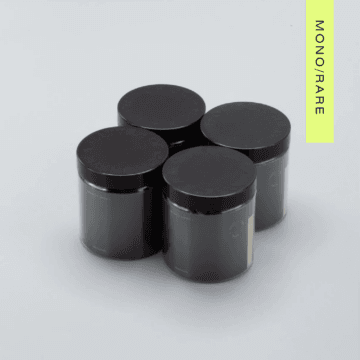
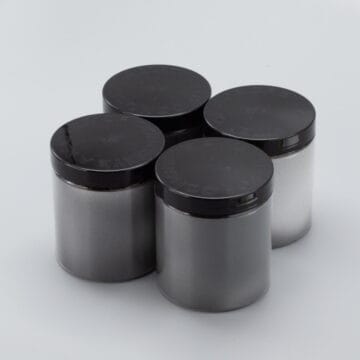
A.M.O.C. JAR
Made from fully recyclable PET. Lightweight, durable, and made to be reused endlessly.
REFILL
A low-waste option, vacuum-packed in thin, food-grade PP without a valve or zipper. About 40% lighter than standard bags and easier to recycle. These are not retail-friendly and may lose vacuum in transit—this doesn’t affect quality. Transfer to a container after opening. Not freezer-safe unless portioned first.
KILO BAG
For larger orders, we use high-barrier packaging that protects freshness and is recyclable under certain conditions. We chose it for both performance and environmental impact.
You’ll find more on our packaging choices and sustainability approach on the about page.
ESPRESSO VS FILTER ROAST
Our filter roasts are designed for clarity and expression, but they’re great for both filter and espresso brewing. In fact, we often prefer the brighter, more expressive profile they bring to espresso.
Espresso roasts, on the other hand, are specifically developed for espresso brewing only. We don’t recommend using them for filter methods, as they’re tailored for higher extraction and a more classic cup profile.
Choose based on your taste and brew method, but know we stand behind both.
ROAST DATE
All our coffees are shipped as fresh as possible, typically within a few days of roasting. We don’t sit on a lot of stock and roast multiple times a week, so what you receive has been roasted recently, usually no longer than a 7-10 days before shipping, but it could also be roasted and shipped the same day.
You’ll find the exact roast date printed on the label. We recommend resting the coffee for a few days after roasting to allow it to degas and open up in flavour.